
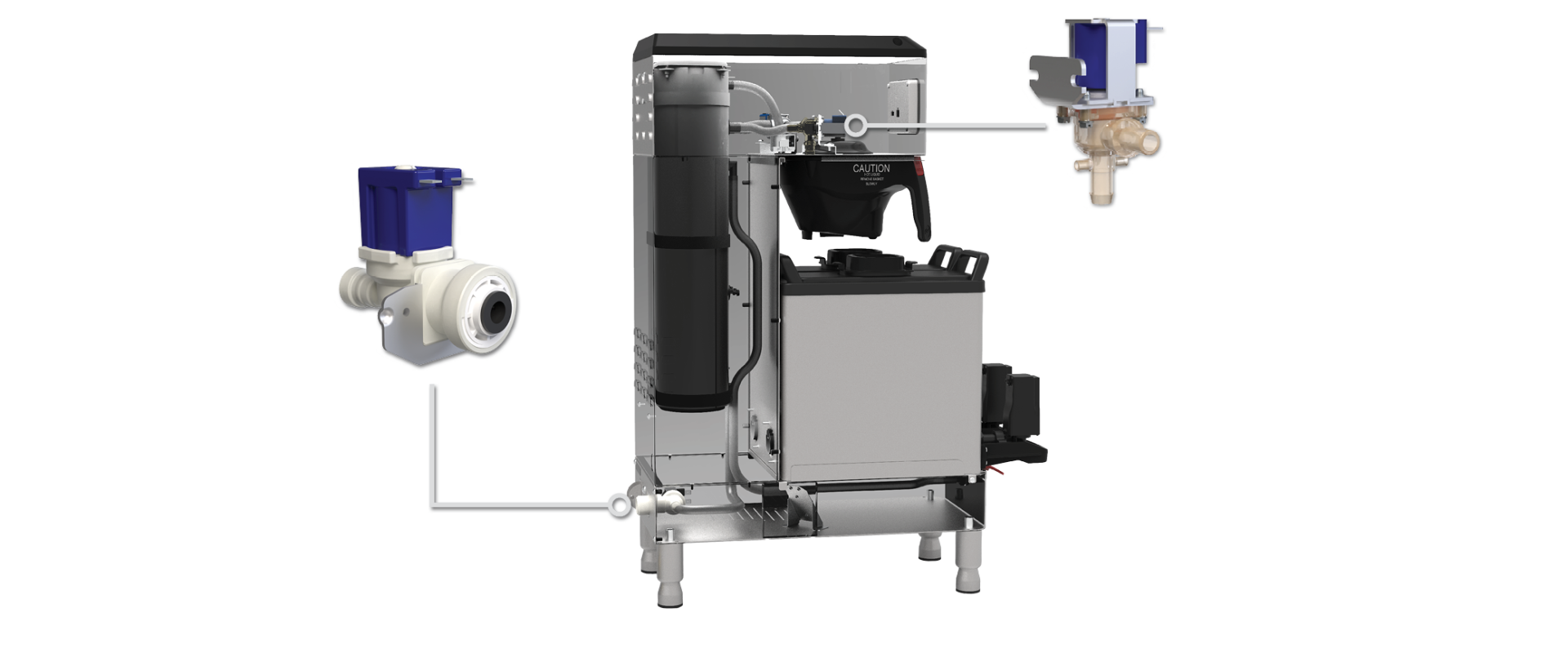
Engineers specifying fluid control components for OEM equipment frequently encounter both terms: water inlet valve and water solenoid valve. They're often used interchangeably in product listings, distributor catalogs, and even manufacturer documentation, which creates real confusion during the design and procurement process.
They are not the same thing, but the relationship between them matters. This article explains what each term means, how they differ in function and application, and how to determine which one you actually need.
What Is a Water Inlet Valve?
A water inlet valve controls the entry of water from an external supply line into a piece of equipment. Its job is straightforward: allow water in when the machine needs it, stop the flow when it doesn't.
In OEM equipment, water inlet valves connect directly to a pressurized water supply like a building water line, a pressurized tank, or a municipal supply connection. The valve stays closed until a control signal opens it, water flows into the machine, and the valve closes again.
Water inlet valves are defined by their role in the system: they sit at the water entry point. The term describes a function and a position in the system, not a specific actuation technology.
Most water inlet valves used in commercial OEM equipment are solenoid-operated, meaning they use an electromagnetic coil to open and close. But the defining characteristic of a water inlet valve is where it sits and what it does, not how it's actuated.
Common applications for water inlet valves:
- Ice machines (controlling water fill into the freezing zone)
- Commercial dishwashers (controlling wash and rinse water supply)
- Washing machines and laundry equipment
- Beverage equipment (controlling water supply to boilers and brew chambers)
- Combi ovens and steam equipment
What Is a Water Solenoid Valve?
A water solenoid valve is any solenoid-actuated valve designed to control the flow of water. The term describes the actuation technology, electromagnetic coil actuation, applied to a water-compatible valve.
Solenoid valves use an electromagnetic coil to generate a magnetic field that moves an internal plunger, opening or closing the valve seat. When the coil is energized, the plunger moves. When power is removed, a return spring moves it back.
"Water solenoid valve" is a broad category. It includes:
- Water inlet valves (at the supply entry point)
- Dispense valves (metering water delivery within or from equipment)
- Diverter valves (directing water between multiple paths)
- Isolation valves (shutting off flow within a circuit)
- Drain valves (controlling water discharge)
A water solenoid valve can appear anywhere in a fluid system. A water inlet valve is always at the supply entry point.
Common applications for water solenoid valves broadly:
- Any application where electrically controlled water flow is required
- Process equipment, industrial automation, HVAC, medical devices
- OEM equipment of all types that handles water or water-based media
Key Differences: Water Inlet Valve vs. Water Solenoid Valve
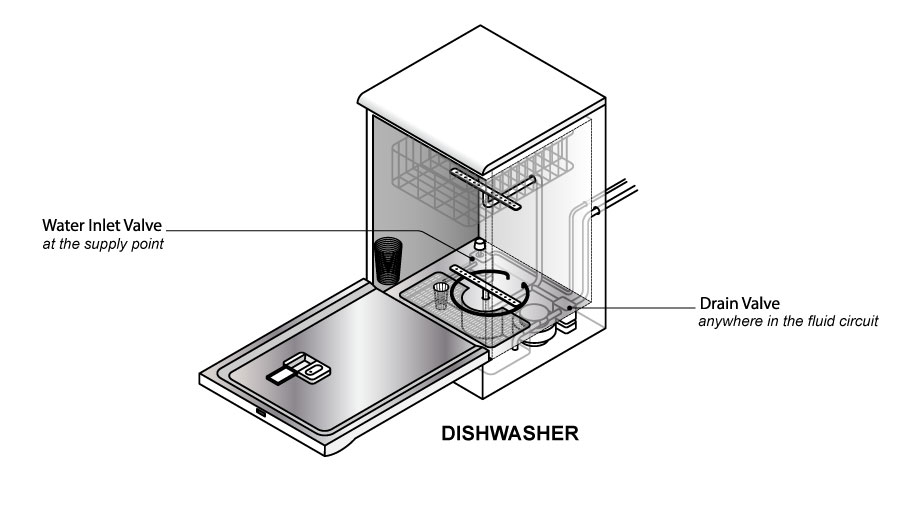
The clearest way to think about it: most water inlet valves used in modern OEM equipment are solenoid valves, but not all solenoid valves are water inlet valves.
When someone says "water inlet valve," they're telling you where the valve lives in the system. When someone says "water solenoid valve," they're telling you how it works.
Why the Confusion Exists
The confusion is understandable for a few reasons.
First, in appliance and food service equipment, the most common OEM applications, the water inlet valve almost always happens to be a solenoid valve. So, the two terms frequently describe the same physical component from different angles.
Third, the terms are sometimes used loosely in RFQs and specifications. An engineer asking for a "water solenoid valve" may mean a water inlet valve specifically — or may mean any solenoid-operated valve for water service. Clarifying the system position and function early in the spec process prevents mismatches.
Water Inlet Valve Design Considerations
Because water inlet valves connect directly to pressurized supply lines, they have specific design requirements that distinguish them from other solenoid valves in a system.
Pilot-Operated Design
In a pilot-operated valve, inlet pressure acts on both sides of a diaphragm and helps hold the valve closed. When the solenoid opens a small pilot passage, pressure above the diaphragm is relieved. The resulting pressure differential lifts the diaphragm and opens the main flow path. This allows a relatively small solenoid to control a much larger flow rate.
The tradeoff: pilot-operated valves require a minimum pressure differential to open, typically 5 psi minimum. For gravity-fed or very low-pressure systems, a direct-acting valve is required instead.
Flow Rate and Port Configuration
Water inlet valves are specified by flow rate (Cv or GPM at rated pressure) and port configuration. Water inlet valves are available in single- and multiple-circuit configurations. Depending on the equipment, a valve assembly may have multiple inlets, multiple independently controlled outlets, or both. Product specifications should distinguish the number of controlled circuits and the number and type of physical connections.
Certifications
Certification requirements depend on the equipment, application and countries in which the finished product will be sold. Depending on the model and application, relevant requirements may include UL recognition, NSF certification or material compliance, and regional potable-water approvals. Always confirm that the selected valve carries the specific approvals required for the finished equipment.
Voltage and Duty Cycle
Water inlet valves are available in common AC and DC voltages, including configurations designed around the equipment’s control system. Duty cycle matters: a valve on a continuous fill cycle needs a continuous-duty coil rating.
Water Solenoid Valve Design Considerations
When specifying a water solenoid valve for applications beyond the inlet point, the considerations shift based on where the valve sits in the system and what it's doing.
Direct-Acting vs. Pilot-Operated
Direct-acting valves generally do not require a minimum pressure differential, making them suitable for zero- or low-pressure applications like dispensing from a tank, controlling flow within a pressurized circuit, or handling backpressure scenarios. They must still be selected within their rated maximum differential pressure and other operating limits.
Media Compatibility
Water is rarely just water in OEM equipment. Ice machine water contains minerals. Beverage equipment handles water at elevated temperatures. Floor scrubber tanks hold detergent solutions. Each application requires seal and body materials selected for the actual media — not just generic "water service."
Common elastomers include NBR, EPDM, FKM and silicone, but suitability depends on the exact fluid composition, temperature, pressure, concentration and required regulatory compliance. Material selection should be confirmed against the actual operating conditions rather than based solely on a water service designation.
Manifold and Multi-Valve Configurations
In equipment with multiple water circuits, individual solenoid valves are sometimes replaced by custom valve manifolds — multiple solenoid-controlled flow paths in a single body. Custom manifolds reduce plumbing complexity, minimize leak points, and can significantly reduce assembly time on the production line. Deltrol's custom assembly capability covers this directly.
Which Valve Do You Need?
Use this as a quick decision guide:
- You need a water inlet valve if:
- You're controlling water entry from a pressurized supply line into equipment
- You're replacing or specifying the valve at the water connection point of an appliance or food service machine
- Your application requires NSF/UL certification for food equipment compliance
- Your system runs at typical supply line pressure (20–125 psi)
You need a water solenoid valve (broader category) if:
- You're controlling water flow at any point within a fluid system
- You need to divert, isolate, or discharge water within a circuit
- You're specifying for a low-pressure, gravity-fed, or variable-pressure system
- You're building a custom fluid circuit that doesn't fit standard inlet valve configurations
When in doubt: describe your system position, operating pressure, flow rate requirement, and media to your valve supplier's engineering team. The right valve category will be clear from those parameters.
Deltrol Water Inlet Valves and Water Solenoid Valves
Deltrol Controls manufactures both water inlet valves and a broad range of water solenoid valves for OEM equipment. Our products are used in commercial ice machines, beverage dispensers, floor scrubbers, dishwashers, and a range of other food service and appliance applications.
Key specifications across our water valve lines:
- Multiple port configurations: 2-way, 3-way, and multi-port options
- Coil voltages: AC and DC, standard and custom voltages available
- Flow-control options: integrated flow restrictors are available to help manage flow rate across the intended operating-pressure range.
- Certifications: UL Recognized and NSF Approved on the majority of water valve models
- Custom engineering — non-standard port sizes, materials, voltages, and form factors available through our engineering team
Water inlet valves are one of our highest-volume product lines. Deltrol is the dominant supplier in commercial ice machine and floor scrubber valve markets in North America, with over 50 years of design and manufacturing experience.
View our water inlet valve line or contact our engineering team to discuss your application requirements.
Frequently Asked Questions
Are water inlet valves and water solenoid valves the same thing? Not exactly. A water inlet valve describes a valve's role — controlling water entry from a supply line. A water solenoid valve describes the actuation technology. Most modern water inlet valves are solenoid-operated, so many physical components are accurately described by both terms. But solenoid valves appear throughout a fluid system, while inlet valves are always at the supply entry point.
Can a water inlet valve be used as a dispense valve? They serve different functions and are optimized differently. Water inlet valves are typically pilot-operated and designed for supply line pressures. Dispense valves are often direct-acting, optimized for low-pressure tank dispensing and high cycle life. Using an inlet valve in a dispense application, or vice versa, can result in performance or reliability issues. Specify based on the actual system position and operating conditions.
What pressure do water inlet valves operate at? Most water inlet valves used in OEM equipment are designed for typical supply line pressures in the 20–125 psi range. Minimum operating pressure (for pilot-operated designs) is typically 3–5 psi differential. Always confirm the minimum and maximum pressure ratings for your specific valve model against your system's actual pressure range.
What certifications are required for water inlet valves in food equipment? In the US, NSF/ANSI 61 certification is standard for water-contact components in food and beverage equipment. UL recognition is commonly required by OEM customers for North American markets. For equipment sold into European markets, WRAS (UK), ACS (France), KTW (Germany), and other regional certifications may apply. Confirm requirements for your specific end markets before specifying.
Does Deltrol offer custom water inlet valves? Yes. Standard catalog configurations cover the majority of OEM applications, but Deltrol's engineering team regularly develops custom valve configurations for non-standard port sizes, voltages, materials, and mounting requirements. Custom assemblies, including multi-valve manifolds, are also available.